
If you're an association sitting on years of member data, event data, and engagement data but still struggling to trust your reports or activate insights, you're not alone.
Most organizations don't have a data problem.
They have a data governance problem.
What Is Data Governance (And Why It Matters for Associations)?
At its core, data governance is about making better decisions about your data and ensuring those decisions stick.
It defines:
- Who owns the data
- Who can access it
- How it's used
- How it's maintained over time
Done right, it:
- Improves reporting accuracy
- Reduces internal confusion
- Enables faster decision-making
- Creates a foundation for AI and advanced analytics
Done wrong, it becomes process without impact.
The Real Problem Associations Face
Across associations, the challenges are consistent:
- Conflicting metrics across teams
- No clear ownership of key data fields
- Manual reporting and reconciliation
- Limited trust in dashboards
- Disconnected systems such as CRM, events, marketing, and finance
This isn't a tooling issue. It's a governance gap.
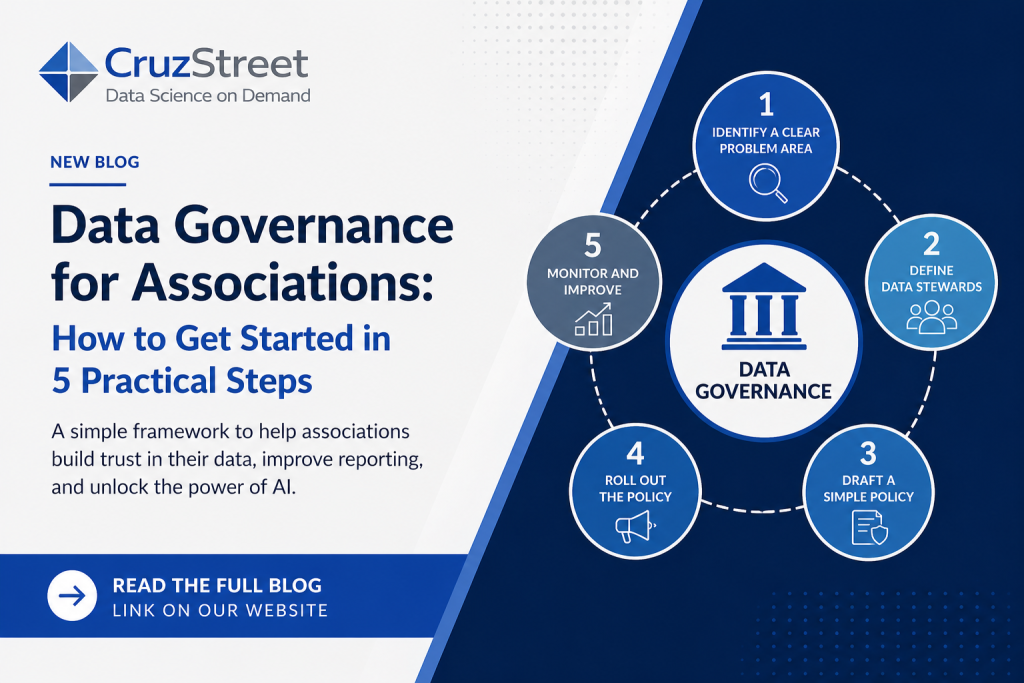
A Practical 5-Step Framework to Get Started
This is the exact framework we walked through in the webinar and it's intentionally simple and actionable.
1. Identify a Clear Problem Area
Start small. Don't try to govern all data. Instead, focus on one high-impact use case:
- Membership reporting
- Event attendance
- Revenue tracking
Governance works best when it's tied to a real business problem.
2. Define Data Stewards
Assign ownership. A data steward is responsible for ensuring data quality, consistency, and usability across systems.
This is where most organizations struggle:
- Everyone uses the data
- No one owns it
Ownership creates accountability, and accountability drives consistency.
3. Draft a Simple Policy
Keep it lightweight. You don't need a long, complex document.
Start with:
- Definitions such as what "active member" means
- Rules around who can update data
- Standards for how data is entered
The goal is clarity, not complexity.
4. Roll Out the Policy
Governance is not a document. It's a behavior change.
This step includes:
- Communicating expectations
- Training teams
- Embedding governance into workflows
If it's not adopted, it doesn't exist.
5. Monitor and Improve
This is where governance becomes powerful.
Track:
- Data quality issues
- Exceptions
- Adoption rates
Governance is not a one-time project. It is an ongoing discipline that improves over time.
Why This Matters Right Now
There is a growing push to implement AI across organizations, but here is the reality: "AI will only amplify the quality of your data."
- Bad data leads to poor outcomes
- Governed data enables scalable intelligence
Organizations that invest in governance today are the ones that will actually see results from AI tomorrow.
Key Takeaways
- Data governance is not about control. It is about clarity and trust
- Start small and tie governance to a real business problem
- Ownership through data stewards is the foundation
- Policies should be simple and actionable
- Governance is a continuous process, not a one-time fix
Better data doesn't start with dashboards. It starts with governance.